
The Most Expensive Decisions in a Custom Home Are Usually the Ones Made Too Late
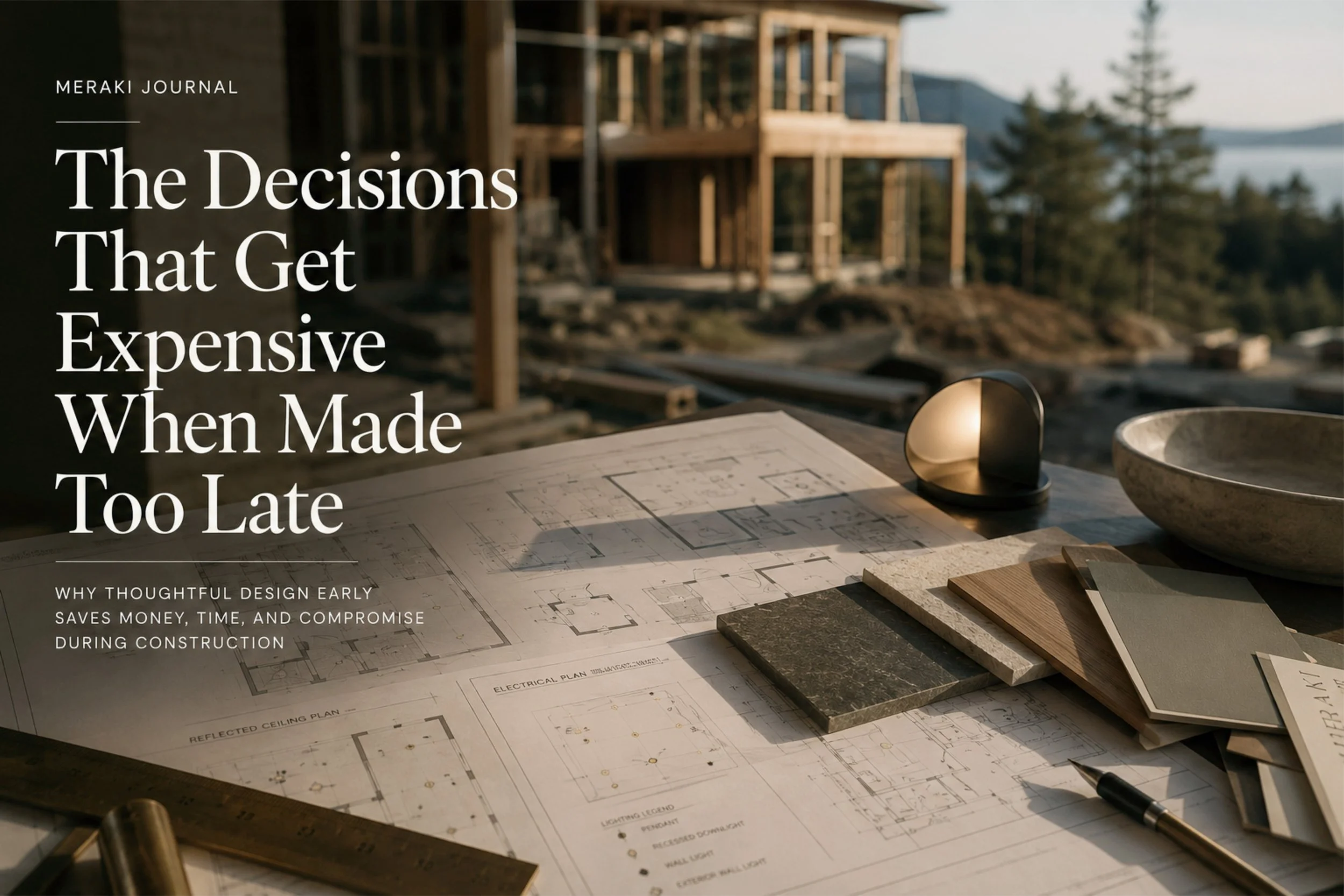
There's a principle that runs through every custom home project, whether the people building it are aware of it or not. The same decision, made at different stages of the process, carries a completely different price tag.
A floor plan change during schematic design costs an hour of drawing time. The same change after framing costs thousands of dollars in labour, materials, and delay. Made after drywall, it may not be reversible at any price.
This isn't a quirk of the construction industry. It's the fundamental economics of how buildings get made. And understanding it — before your project begins — is one of the most valuable things you can do to protect your budget, your timeline, and the home you set out to build.
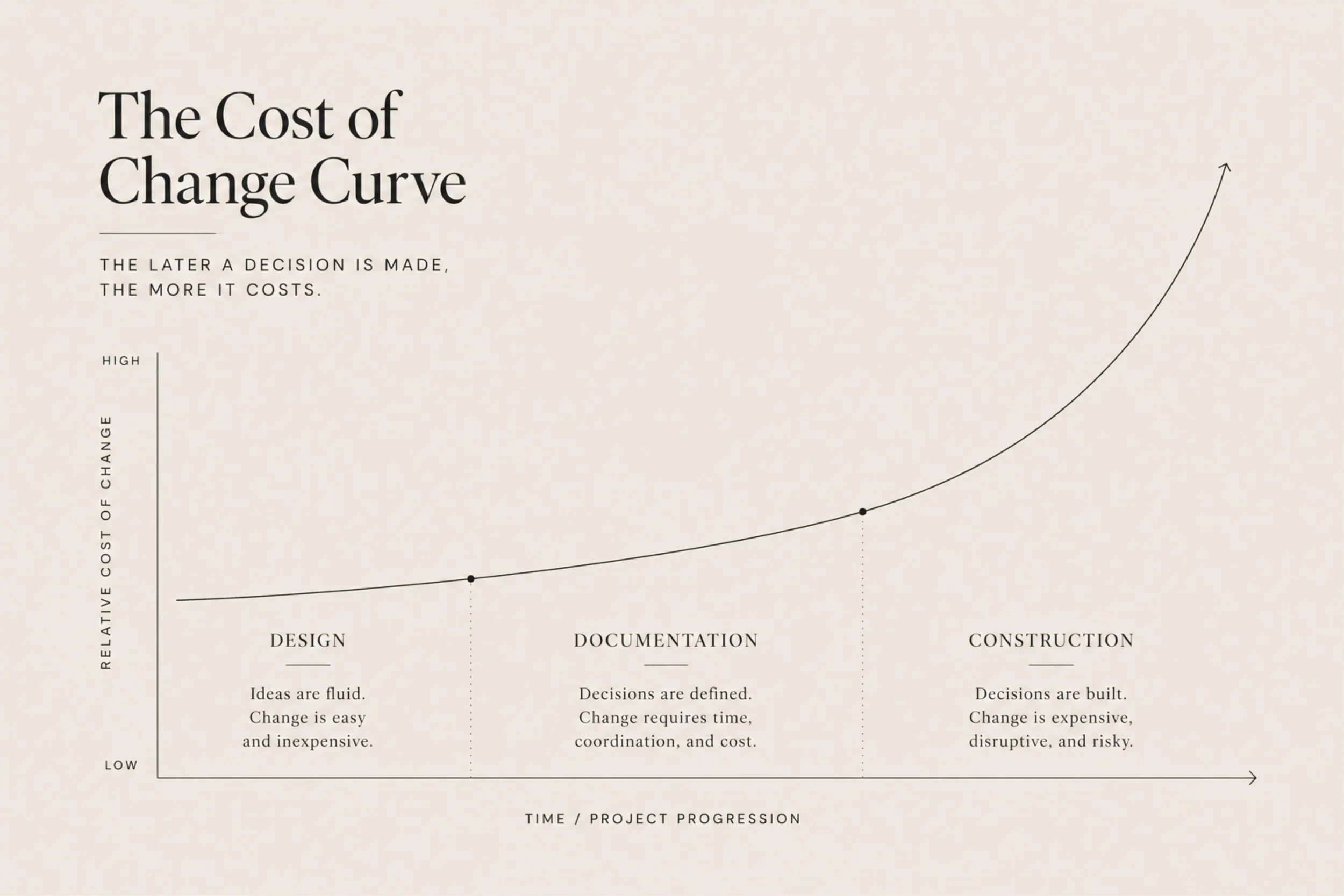
The cost of change curve
Design professionals sometimes talk about the cost of change curve — the idea that the cost of making a decision increases exponentially as a project progresses. In the earliest stages of design, everything is fluid. Ideas can be tested, discarded, and replaced without consequence. A concept that doesn't work costs nothing to abandon.
As the project moves through design development, documentation, permit, and into construction, that fluidity disappears. Decisions become embedded in drawings, then in materials, then in structure. Changing them requires undoing work that has already been done and redoing it — at full construction cost.
The clients who finish on budget are almost always the ones who made their decisions early. Not because they were more decisive by nature, but because they had a design process that gave them the time, information, and structure to make good decisions before the consequences of making them late became real.
When decisions don't get made during design
The most common source of budget overruns in custom home construction isn't a single dramatic change. It's the accumulation of decisions that weren't made during design and had to be made during construction instead.
Some of these are obvious — a room that turns out to be the wrong size, a layout that doesn't flow the way the client imagined, a site relationship that wasn't fully resolved before documentation began. These are the decisions most people think of when they think about design changes.
But there's another category of decision that is less visible, less discussed, and in many ways more consequential. These are the decisions that don't produce a single expensive moment — they produce a finished home that feels like it was built rather than designed. A home that functions but doesn't feel considered. A home that almost reflects the original vision but carries the quiet, persistent evidence of details that were figured out on site rather than resolved on paper.
These decisions are almost always the result of the same cause: comprehensive design wasn't completed before construction began.
The decisions that separate a designed home from a built one
Rough-in locationsPlumbing rough-in happens early in construction and it is largely irreversible once the slab is poured or the walls are closed. A shower valve rough-in that doesn't align with the specified fixture. A toilet positioned too close to the vanity because the rough-in was placed without reference to the final cabinetry layout. A kitchen rough-in located for a standard configuration rather than the custom cabinetry that came later.
These aren't dramatic failures. But they produce compromises that live in the home forever. Preventing them requires knowing exactly what fixtures and cabinetry are going in before rough-in begins. That's a design decision, not a construction one — and it needs to be made weeks before the plumber arrives on site.
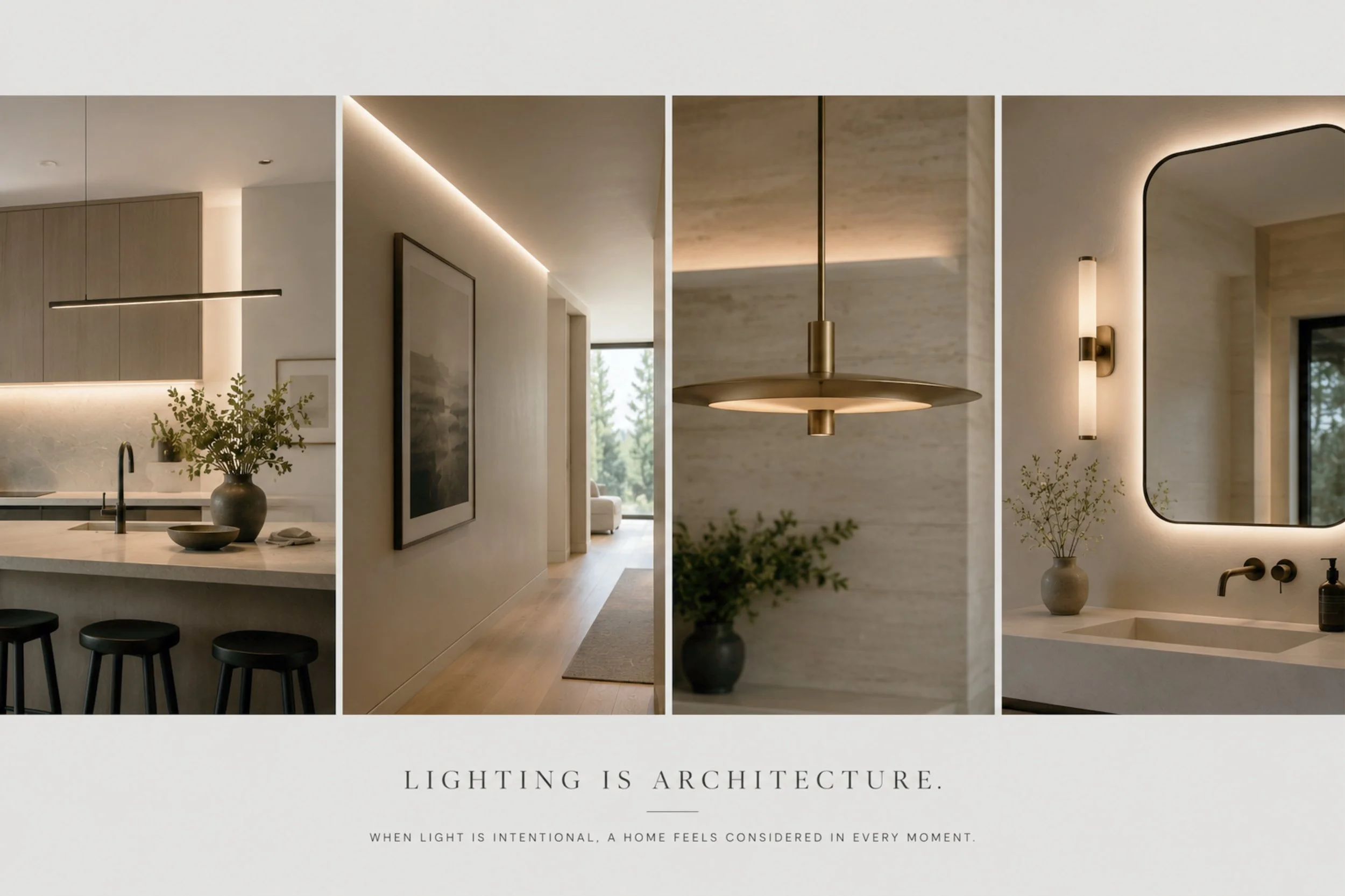
Electrical locations and lighting design This is one of the most underestimated decisions in the entire build process — and one of the most consequential for how a finished home feels.
Lighting is not an afterthought. It is the single variable that most determines whether a home feels considered or generic. The difference between a home with thoughtfully designed lighting — layered sources, fixtures positioned to wash a wall texture, pendants hung at the right height over the right surface, exterior lighting that makes the house feel inhabited and grounded after dark — and one where pot lights were placed on a grid by an electrician making reasonable assumptions is not subtle. It is the difference between a home that feels alive and one that feels like a display suite.
Electrical rough-in happens once. Changing a fixture location after drywall means cutting, patching, and repainting. Changing a location that requires a new circuit means opening walls. These decisions need to be made during design development — when fixture types, furniture layouts, and material selections are resolved together rather than in isolation. Lighting that is designed as part of the architecture, not added to it afterwards, is one of the clearest markers of a home that was truly designed.
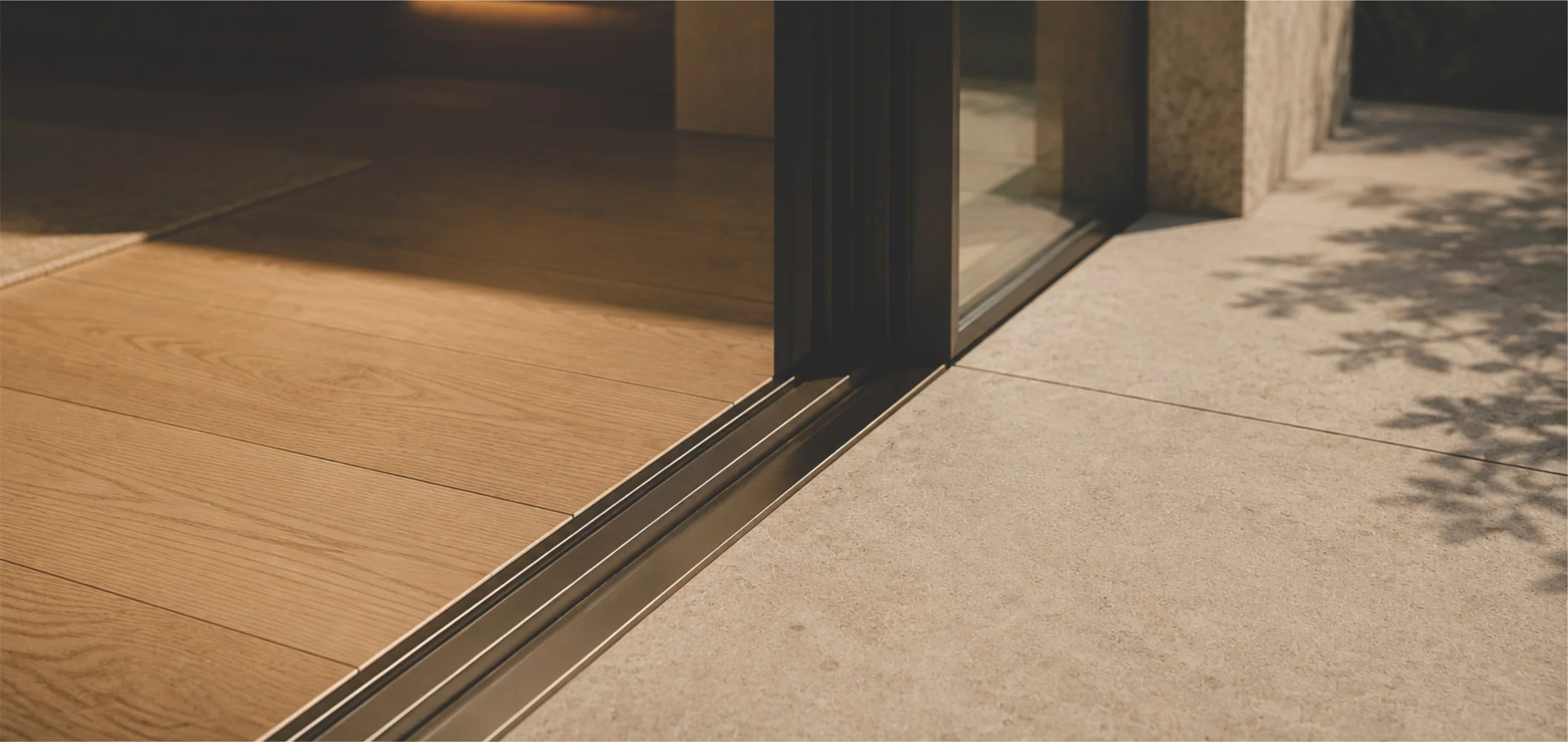
Floor thickness and door thresholds A transition between flooring materials that wasn't resolved during design produces one of the most visible markers of a builder-spec home — a threshold detail that was figured out on site, with whatever solution was available, rather than designed with intention.
Different flooring materials have different thicknesses. Where they meet — at doorways, between rooms, at transitions to exterior spaces — needs to be coordinated in the drawings so that subfloor heights, door hardware, and transition details are all resolved before installation begins. When they're not, the result is always a compromise. You notice it every time you walk through the door. You may not be able to name it — but you feel it.
Strapping and cladding transitionsWhere two exterior cladding materials meet is one of the details that most clearly separates a home that feels architecturally resolved from one that feels assembled. Board and batten meeting stone. Metal panel transitioning to timber. Cladding wrapping a corner or terminating at a window frame.
The thickness of the strapping behind each material, the reveal between them, the alignment with surrounding elements — these need to be drawn and specified before the first piece of cladding goes up. Left to be determined on site, the result is a transition that works structurally but carries the evidence of a decision that wasn't made at the right time. In a home where everything else has been carefully considered, an unresolved cladding transition stands out in a way that is difficult to explain and impossible to ignore.
Millwork and cabinetry Generic millwork is one of the fastest ways to make a custom home feel like it wasn't. Cabinetry specified from a standard catalogue without being drawn into the space — without considering the ceiling height, the relationship to windows, the alignment of reveals and shadow gaps, the integration of appliances and hardware — produces kitchens and bathrooms that function but don't feel designed.
Custom millwork that was drawn in context — that responds to the specific proportions of the room it lives in, that was designed alongside the architecture rather than inserted into it — feels completely different. The upper cabinets relate to the ceiling. The island proportion responds to the room. The hardware scale is considered. The difference is almost always traceable to whether the designer resolved the millwork during design development or left it to be worked out by the cabinet maker from standard dimensions.
Conduit for technology and outdoor systems Every client wants flexibility. The ability to add outdoor speakers, change the television location, extend a smart home system, add outdoor lighting circuits, accommodate an EV charger. Conduit is inexpensive. Running it during framing costs almost nothing. Running it after walls are closed costs significantly — and sometimes isn't possible without visible surface mounting.
The same applies to outdoor lighting conduit, irrigation control wiring, and future-proofing for systems that haven't been fully decided yet. These decisions require a specific conversation during design — a detailed conversation about how the household intends to use the home and what they might want in five or ten years. Left unasked, they produce a finished home that requires expensive retrofitting for things that could have been resolved for almost nothing.
The cumulative effect
None of these details is catastrophic in isolation. A threshold that doesn't transition cleanly. A light switch in a slightly awkward position. A cladding junction that was resolved on site rather than designed intentionally. A millwork reveal that doesn't align with the window frame above it.
But they accumulate. And their cumulative effect is the difference between a home that feels like every detail was considered — and one that feels like reasonable decisions were made by capable people working without complete information.
The first kind of home feels designed. The second kind feels built. The budget difference between them is often surprisingly small. The difference in how they feel to live in is everything.
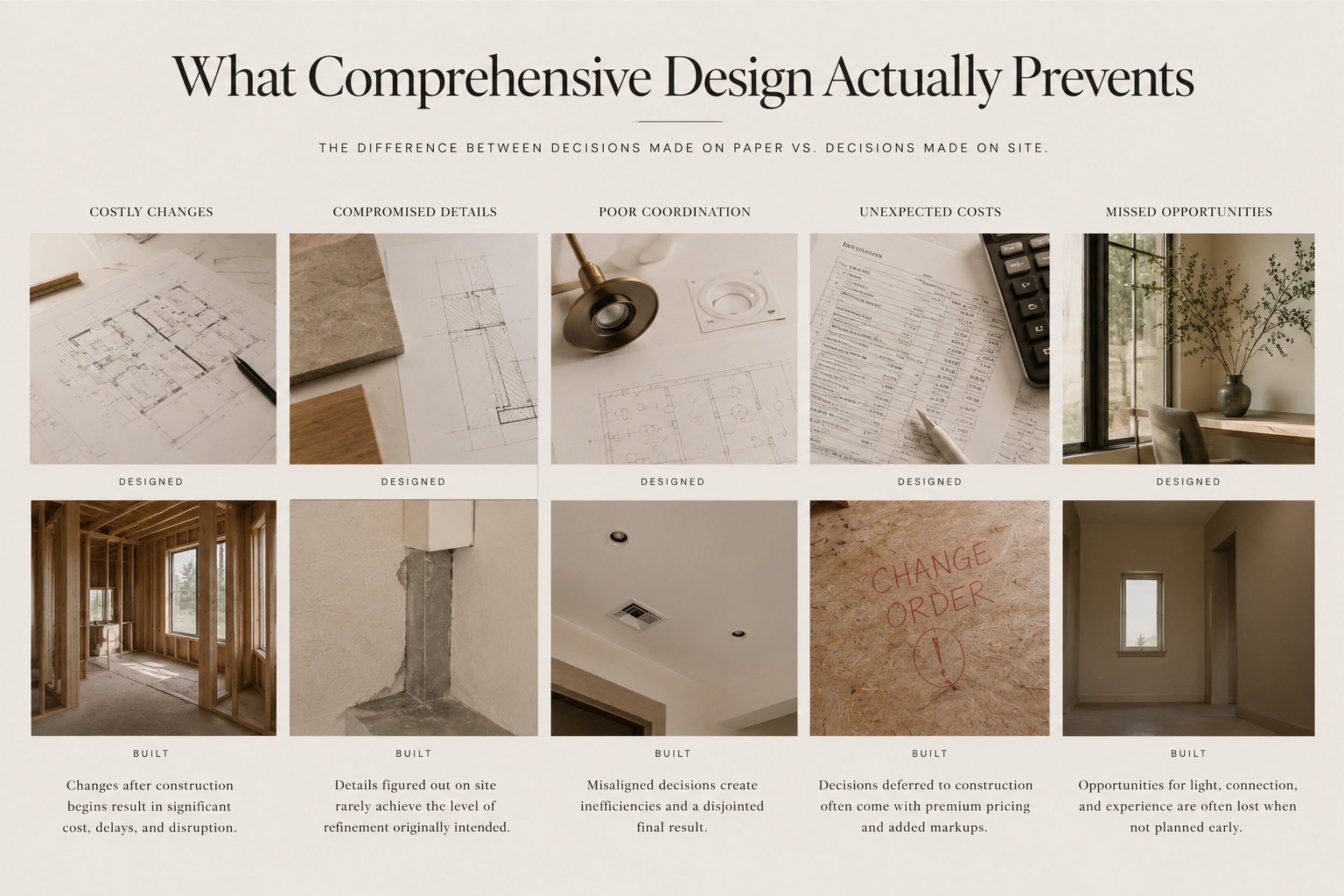
What comprehensive design actually prevents
The phrase "comprehensive design" gets used loosely in the industry. What it means in practice is a design process that doesn't end when the floor plan is resolved — that continues through the detailing of every material transition, every fixture location, every threshold condition, every lighting position, every technology provision, until the drawings contain enough resolved information that a contractor can build from them without making design decisions on site.
This level of documentation takes time. It requires a designer who thinks about construction, not just composition. It requires the client to make decisions about fixtures, finishes, and systems earlier than feels natural — before the home exists, before they can stand in the space and know for certain what they want.
But those decisions are going to be made one way or another. The only question is when — and what it costs to make them at that moment rather than an earlier one.
Change orders are where budgets go wrong
Almost every significant budget overrun in custom home construction traces back to the same source — decisions that weren't made during design and became change orders during construction. A change order is simply a decision made at construction cost rather than design cost. Each one is a moment where something that could have been free became expensive.
Contractors price based on what's in the drawings. When decisions are unresolved at tender, builders carry contingency to protect themselves — and that contingency shows up in your price. A complete, thoroughly resolved set of drawings produces more accurate pricing, less contingency, and fewer change orders. Incomplete drawings produce higher tenders, more surprises, and a construction process where the budget is a moving target rather than a known quantity.
The conversation that prevents all of this
The antidote to late decisions is a design process that is structured specifically to make decisions at the right time — and a designer who knows which questions to ask, and when, to make that possible.
Before rough-in: fixture and fitting selections, cabinetry layouts, floor material transitions, electrical and lighting design.
Before cladding: all exterior material selections, transition details, window and door surrounds, strapping specifications.
Before framing is complete: all conduit and rough-in provisions for technology, outdoor systems, and future flexibility.
Before documentation is complete: every threshold condition, every material meeting, every detail that will be built from the drawings rather than figured out on site.
This isn't a exhaustive list. It's a way of thinking — a habit of asking "when does this decision need to be made, and what does it cost to make it later?" that runs through every stage of a well-managed design process.
The clients who end up with homes they love — homes that feel considered in every detail, that don't carry the quiet evidence of decisions made under pressure — are almost always the ones whose designer asked these questions early enough that the answers could shape the outcome rather than react to it.
Meraki Shane Design Studio is a boutique residential design studio designing custom homes across the Okanagan, Vancouver Island, and throughout British Columbia. We take on a limited number of projects each year — because the work we do requires full attention, and full attention requires limits.
