
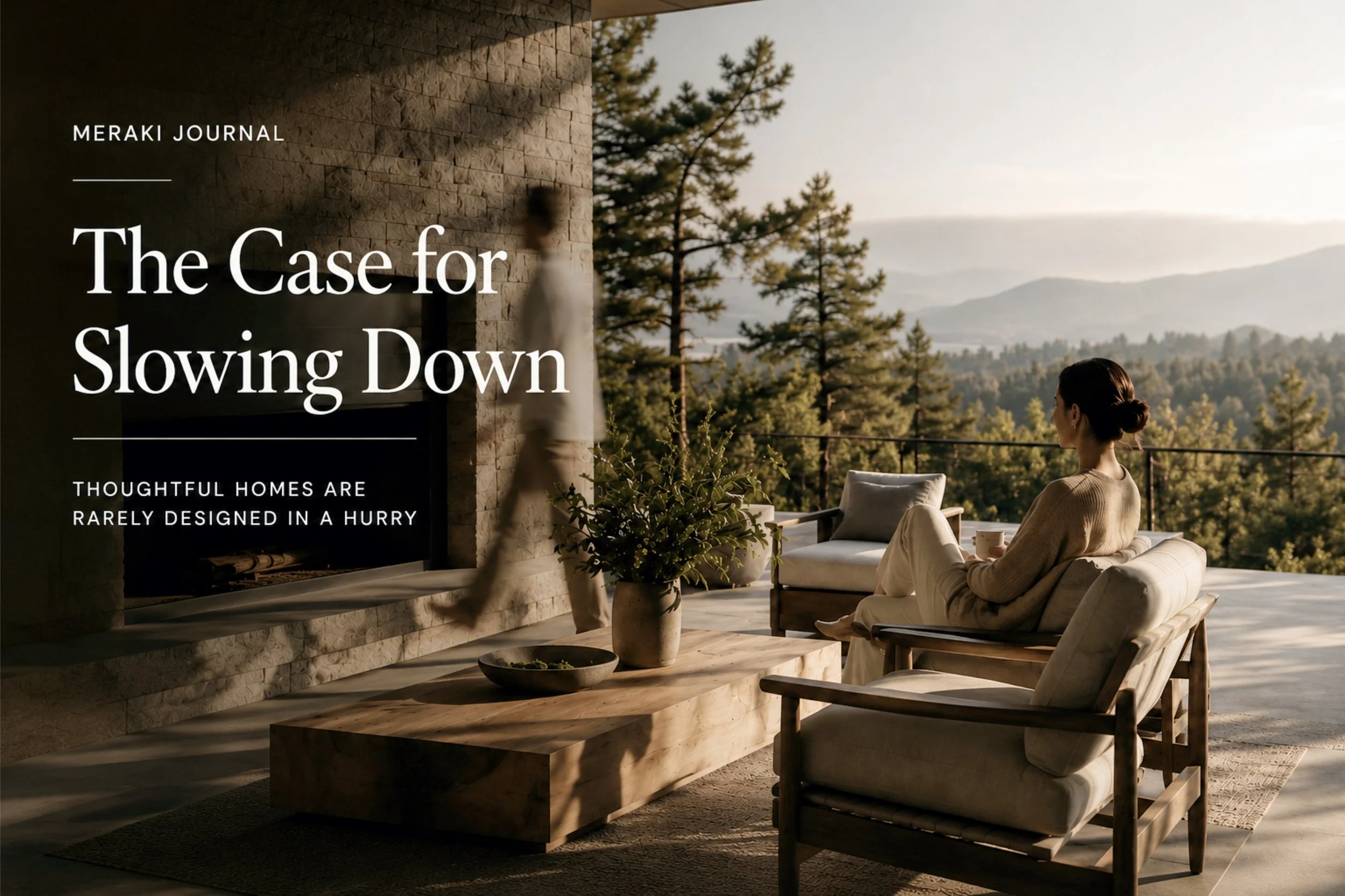
The Case for Slowing Down — Thoughtful Homes Are Rarely Designed in a Hurry
There's a particular kind of pressure that arrives with a custom home project. You've found the land. You've been thinking about this for years. You're ready. The natural instinct is to move — to get drawings started, to get a builder lined up, to get the process underway as quickly as possible.
That instinct is understandable. It's also one of the most common sources of regret we see in custom home building in BC.
The homes that people love most — the ones they're still talking about ten years after they moved in, the ones that feel effortless to live in and somehow get better with time — are almost never the ones that were designed quickly. They're the ones where someone slowed down long enough to get it right.
Here's what slowing down actually means in the context of a custom home design process, and why it's the most valuable thing you can do before you break ground.
The design phase is the only time decisions are free
Every decision in a custom home project has a cost. The difference is when that cost is paid.
A decision made during the design phase — changing a room layout, shifting a window, reconsidering a roofline — costs time and thought. That's it. The same decision made during construction costs time, thought, materials, and labour. Made after construction, it may not be reversible at any price.
The design phase is the only moment in the entire project when you can hold an idea up to the light, turn it around, reconsider it, and change your mind without financial consequence. A process that rushes through design to get to construction is a process that moves the cost of decisions from the cheapest possible moment to the most expensive one.
Slowing down during design isn't inefficiency. It's the highest-return investment available to anyone building a custom home.
Your site deserves more time than most people give it
One of the things that separates a home that feels inevitable — as though it couldn't exist anywhere else — from one that feels placed is how deeply the design responds to the land it sits on.
Understanding a site takes time. It means being on the land at different times of day and in different seasons. It means understanding how water moves across it, where the frost sits longest in winter, where the afternoon heat concentrates in summer. It means knowing which views are worth framing and which are better left unacknowledged. It means understanding not just what the site allows but what it's asking for.
A design process that begins with a floor plan and then asks how to fit it on the site has the relationship backwards. The site comes first. Always. And giving it the attention it deserves requires time that a rushed process simply doesn't allow.
The brief takes longer to develop than most clients expect
Before a designer draws anything, there is work to do that has nothing to do with drawing. It's the work of truly understanding how you live — not how you think you live, or how you imagine you'll live in a new home, but how you actually move through your days.
Where do you end up at the end of an evening? How do you use your kitchen — do you cook seriously or mostly heat things up? Do you work from home, and if so, do you need to be separated from the household or connected to it? How do you want the house to feel on a Tuesday morning in November versus a Saturday afternoon in July?
These questions sound simple. They're not. Most people haven't thought carefully about them, and the answers that emerge in the first conversation are often different from the ones that come out of the third or fourth. A brief that has been developed slowly and thoughtfully produces a home that fits. A brief that was assembled quickly produces a home that almost fits — and almost is the gap you'll notice every single day.
Good design requires iteration
The first concept is rarely the best one. This isn't a reflection of the designer's ability — it's how design works. Ideas need to be tested against reality, against the site, against the brief, against constructability. The first pass reveals things that couldn't have been known at the start. The second pass refines them. The third pass resolves them.
A process that doesn't allow time for iteration is a process that delivers the first idea rather than the best one. In a custom home that will cost hundreds of thousands of dollars to build and decades to live in, the difference between the first idea and the best one is worth the time it takes to find it.
Documentation is where design intent becomes buildable reality
Even after the design is resolved, the work of translating it into construction documentation requires care and time that is easy to underestimate. A well-developed set of drawings doesn't just show what the home looks like — it shows how it goes together. How materials meet. How details are resolved. How the structure relates to the envelope. How mechanical and electrical systems are integrated without compromising the design.
This is the documentation your contractor prices from, your engineers coordinate with, and your municipality reviews for permit. Drawings that have been rushed through this stage carry unresolved questions into construction — and unresolved questions in construction are expensive to answer.
Thorough documentation takes time. It is also the single most effective thing a design team can do to protect your budget, your timeline, and your vision through the build process.
What slowing down actually looks like in practice
Slowing down doesn't mean a design process without momentum or direction. It means giving each stage the time it actually requires rather than the time it would take if everything went perfectly.
It means starting the design conversation before you feel ready — ideally before you've purchased land, certainly before you've committed to a builder or a timeline. It means allowing the brief to develop through real conversation rather than a single intake meeting. It means reviewing concepts with genuine curiosity rather than pressure to move on. It means treating the documentation phase as the foundation of your build rather than an administrative step on the way to breaking ground.
The clients who love their homes most are almost always the ones who gave the process the time it deserved. Not because they had unlimited time — most of them had the same pressures and the same eagerness to move in as everyone else. But because somewhere in the process they made a conscious decision to prioritise getting it right over getting it done.
That decision shows up in every room, every morning, for as long as they live there.
Meraki Shane Design Studio is a boutique residential design studio designing custom homes across the Okanagan, Vancouver Island, and throughout British Columbia. We take on a limited number of projects each year — because the work we do requires full attention, and full attention requires limits.
